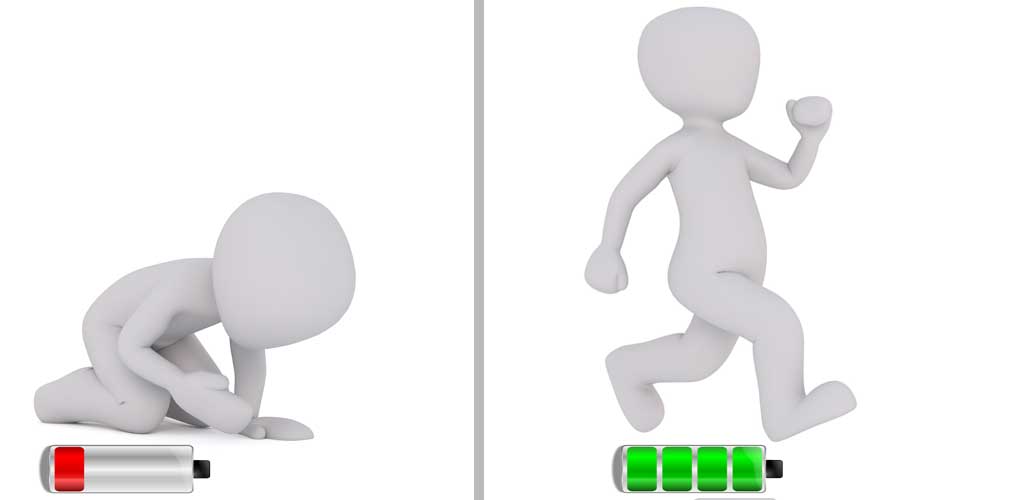
Find cause of fatigue to get health
It is possible to get better from fatigue, brain fog, stomach problems and migraines.
Finding the cause of fatigue or illness to get health

If you’ve experienced exhaustion, you know there’s a difference between it and just being tired. Exhaustion digs deeper and drags down your motivation and emotional and physical energy. Fatigue also doesn’t seem to be relieved by just getting a little extra rest and relaxation and it can feel frustrating.
Read through the section below about some common causes of exhaustion and illness.
Then do tests on what you assume is the cause of your fatigue or disease, such as blood tests for iron deficiency or Omega-3 deficiency or avoid gluten if your stomach is sensitive.
The test results can give an indication of deficiencies that show whether diet should be changed or if supplements are needed.

My migraines have decreased a lot after the sodium salt intake has decreased. About 15% of the population suffers from migraines and their troublesome headaches.
Salt is used everywhere as a cheap seasoning in cooking, but we eat 11 times more sodium salt than we need. Too much sodium salt increase blood pressure and causes cardiovascular diseases, skin problems, as well as headaches and sometimes migraines.
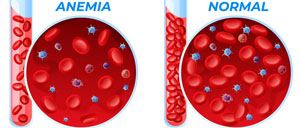
Lack of iron is called anemia and is the most common nutritional deficiency worldwide and causes a lack of oxygen transport in the body, can lead to fatigue, headaches, restless legs, depression, or anxiety.
Low iron levels mainly affects women but also men affects, levels can be diagnosed through common blood tests that anyone can get, even in private laboratories quite cheap.

Exhaustion can be due to genetically modified gluten that the stomach has had too much of over the years. It can get better and make a difference if the stomach and intestines are allowed to recover by avoiding gluten for 1-2 weeks.
Having stomach pain or balloon stomach or IBS is problematic, then postbiotic and milder diet as Low FODMAP can help the stomach get better.
Hiccups – magnesium often helps

If I get hiccups, I use magnesium effervescent, take a quarter tablet and put in 2 tablespoons of water, then have it under my tongue in my mouth for a few minutes until the hiccups disappear.
Hiccups are caused by the diaphragm muscle contracting in a spasmodic manner.
Magnesium usually helps muscles relax and reduce cramps. By having water-soluble magnesium fizz in the mouth for a while, it is absorbed into the bloodstream via the lining of the mouth and works within a few minutes.
Magnesium effervescent tablets available at food stores, pharmacies and health stores.
Restless legs – helps with vitamins or iron

Since I discovered that Vitamin-B removes Restless Legs, I take it regularly. It could also be due to iron deficiency, see further up regarding exhaustion and iron intake.
Many suffer of restless legs, it is a strange feeling inside the legs and not on the surface. The sensation can be described as creeping, crawling, itching, aching or electric.
Eating the wrong diet can cause vitamin B deficiency, but it can also be caused by damaged intestinal flora that does not absorb the nutrients. Vitamin B is important and can be taken as a dietary supplement if the body has problems producing it itself, it is also needed for the formation of red blood cells and for the nervous system and brain to function.
B-vitamins are found in foods such as meat and whole grains, as well as in supplements and typically contains niacin (B3), folic acid (B9), and vitamin B12, which can be found in pharmacies and health stores.
Cramp – often helps with minerals

Anyone can suffer from cramps, both athletes and ordinary people lying in bed.
Cramping is a sudden, involuntary, painful contraction of the skeletal muscles. Although they are generally temporary and non-harmful, they can cause significant pain and a paralysis-like immobility of the affected muscle.

Doctor Decker says that the cause of cramping is usually a lack of magnesium or a lack of potassium salt. Depending on the situation in which the cramp occurs, it is possible to determine which mineral is deficient.
If athletes get cramps at the beginning of their workout even though they have full stores of electrolytes in their body, then it’s a lack of magnesium. The same if people are sitting on the couch or resting and getting cramps, then there is a lack of magnesium. The body has the ability to limit levels of magnesium, therefore it takes time to switch up the body’s stores even if quality magnesium is added.
However, if athletes get cramps after 1 or 2 hours of training, then there is a lack of potassium salt. Even football players often get cramps when there is extra time on regular playing time because then one of the minerals such as potassium salt starts to run out. The body lacks the ability to limit levels of potassium salt, which makes it reasonably easy to increase potassium salt in the body, therefore excessive amounts of potassium salt should not be replenished at the same time.
Tiredness – bad ventilation oxygen shortage
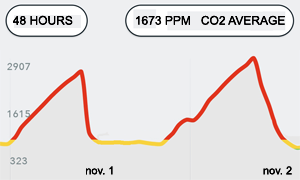
The picture shows how carbon dioxide increases more and more when we sleep in a room.
Carbon dioxide decreases when we leave the bedroom. Many people underestimate how the oxygen supply in our homes affects health, older homes often have poor ventilation.
By airing out a minute or short time before bedtime and a short time directly in the morning, it can provide more oxygen so it affects health positively.
Stroke, brain damage and depression can make people isolated, and then it is extra important to have oxygen and avoid poor ventilation that can cause fatigue.
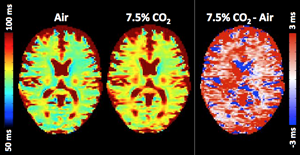
The brain in the middle image is affected by 7.5% more carbon dioxide than the one on the left.
The right picture shows the differences in how carbon dioxide affects, areas in red are polluted by carbon dioxide.
Researchers studied how carbon dioxide affects office workers when they perform various thought tasks. Their capacity decreased by 15% when carbon dioxide increased to 945 ppm. But when carbon dioxide increased further to 1400 ppm, mental capacity decreased by 50%.
The normal level of carbon dioxide in the outdoor air is 407 ppm.
All the time when we breathe, oxygen is consumed and carbon dioxide is formed. Most people can’t hold their breath for more than 1-2 minutes.
A lack of oxygen affects the brain dramatically. The cells that make up the brain begin to die off after about five minutes without oxygenation. This is called a cerebral infarction, or ischemic stroke, and shows how dangerous an episode of oxygen deprivation in the brain can be.


M Harrington, S Grant. Huntington Medical Research. March 2019. Research team discovers link between sodium and migraines before pain occurs.
W McNeely, K Goa, Drugs. 1999. Potassium in migraine: a review. Jun;57(6):991-1003. doi: 10.2165
J. Titze, M. Rauh et al. Increased salt consumption induces body water… May 2017, Journal of Clinical Investigation
Strazzullo P, D’Elia L, Kandala NB, Cappuccio FP. Salt intake, stroke, and cardiovascular disease: meta-analysis of prospective studies. BMJ. 2009;339:b4567. [PMC free article] [PubMed] [Google Scholar]
Titze J, Kopp C, Linz P, Wachsmuth L, Dahlmann A, Horbach T. (23)Na magnetic resonance imaging of tissue sodium. Hypertension. 2012 Jan;59(1):167-72
Xu WJ, Barisano G, Phung D, Chou B. Structural MRI in Migraine: A Review of Migraine Vascular and Structural Changes in Brain Parenchyma. J Cent Nerv Syst Dis. 2023 Apr 14
Coincon, M., Uzdavinys, P., Nji, E. et al. Crystal structures reveal the molecular basis of ion translocation in sodium/proton antiporters. Nat Struct Mol Biol 23, 248–255 (2016).
Blaustein MP, Leenen FH, Chen L, Wier WG. How NaCl raises blood pressure. Am J Physiol Heart Circ Physiol. 2012 Mar 1;302(5):H1031-49.
World Health Organization. March 2023, Massive efforts needed to reduce salt intake and protect lives
Gunn J. and Levings J. Public health analyst, 2014, The Imbalance of Sodium and Potassium Intake
Jennifer Adler, Passionate Nutrition: A Guide to Using Food as Medicine from a Nutritionist Who Healed Herself from the Inside Out (Seattle: Sasquatch Books, 2014)
Gerard Mullin, MD, The Gut Balance Revolution: Boost Your Metabolism, Restore Your Inner Ecology, and Lose the Weight For Good! (New York: Rodale, 2015).
Katherine Harmon, “Salt Linked to Autoimmune Diseases,” Nature (6 March 2013), republished in Scientific American. http://www.scientificamerican.com/article/salt-linked-to-autoimmune-diseases/. Accessed March 1, 2015.
Michael B. Fowler, MD, “Salt, Hypertension, & Heart Failure” in Gazzaniga, The No-Salt, Lowest-Sodium, Living Well Without Salt Cookbook.
Faraco et al. Dietary salt promotes neurovascular and cognitive dysfunction through a gut-initiated TH17 response. Nature Neuroscience. January 15, 2018. doi:
Costantino et al. Hold the salt: gut reaction may impair the brains of mice. National Institutes of Health. January 2018
National Heart Lung and Blood Institute, National Institutes of Health. Your Guide to Lowering Your Blood Pressure with DASH. Accessed May 14, 2012.
Yang Q, Zhang Z, Kuklina EV, Fang J, Ayala C, Hong Y, Loustalot F, Dai S, Gunn JP, Tian N, Cogswell ME, Merritt R. Sodium intake and blood pressure among US children and adolescents, by weight status. Pediatrics 2012; 130(4): 611–619.
Saldeen T. Fiskolja och hälsa med fokus på naturlig stabil fiskolja. SwedeHealth Press. Uppsala 1-64, 1997.
Mason RP, Sherratt SC. Omega-3 fatty acid fish oil dietary supplements contain saturated fats and oxidized lipids that may interfere with their intended biological benefits. Biochem Biophys Res Commun. 2016 Dec 21. pii: S0006-291X(16)32187-8. [Epub ahead of print]
A.C. Kleiner, D.P. Cladis, C.R. Santerre. A comparison of actual versus stated label amounts of EPA and DHA in commercial omega-3 dietary supplements in the United States
J. Sci. Food Agric., 95 (2015), pp. 1260–1267.
B.B. Albert, J.G. Derraik, D. Cameron-Smith, P.L. Hofman, S. Tumanov, S.G. Villas-Boas, M.L. Garg, W.S. Cutfield Fish oil supplements in New Zealand are highly oxidised and do not meet label content of n-3 PUFA Sci. Rep., 5 (2015), p. 7928.
J.A. Berliner, A.D. Watson A role for oxidized phospholipids in atherosclerosis N. Engl. J. Med., 353 (2005), pp. 9–11.
M. Bertelsen, E.E. Anggard, M.J. Carrier Oxidative stress impairs insulin internalization in endothelial cells in vitro Diabetologia, 44 (2001), pp. 605–613.
J.W. Baynes Role of oxidative stress in development of complications in diabetes Diabetes, 40 (1991), pp. 405–412.
R. Turner, C.H. McLean, K.M. Silvers Are the health benefits of fish oils limited by products of oxidation? Nutr. Res. Rev., 19 (2006), pp. 53–62.
M.F. Walter, R.F. Jacob, R.E. Bjork, B. Jeffers, J. Buch, Y. Mizuno, R.P. Mason Circulating lipid hydroperoxides predict cardiovascular events in patients with stable coronary artery disease: the PREVENT study J. Am. Coll. Cardiol., 51 (2008), pp. 1196–1202.
M.F. Walter, R.F. Jacob, B. Jeffers, M.M. Ghadanfar, G.M. Preston, J. Buch, R.P. Mason Serum levels of thiobarbituric acid reactive substances predict cardiovascular events in patients with stable coronary artery disease: a longitudinal analysis of the PREVENT study J. Am. Coll. Cardiol., 44 (2004), pp. 1996–2002.
Läkemedelsverket: Ateroskleros – Livets fiende nr 1 [Internet: http://www.lakemedelsvarlden.se/nyheter/ateroskleros-%E2%80%93-livets-fiende-nr-1-1331]
Internetmedicin. Ateroskleros (åderförkalkning) [Internet: http://www.internetmedicin.se/page.aspx?id=2787]
N. Lamharzi, C.B. Renard, F. Kramer, S. Pennathur, J.W. Heinecke, A. Chait, K.E. Bornfeldt
Hyperlipidemia in concert with hyperglycemia stimulates the proliferation of macrophages in atherosclerotic lesions: potential role of glucose-oxidized LDL. Diabetes, 53 (2004), pp. 3217–3225.
P. Libby, Inflammation in atherosclerosis. Nature, 420 (2002), pp. 868–874.
M. Rizzo, K. Berneis Low-density lipoprotein size and cardiovascular risk assessment QJM, 99 (2006), pp. 1–14.
S. Koba, T. Hirano, Y. Ito, F. Tsunoda, Y. Yokota, Y. Ban, Y. Iso, H. Suzuki, T. Katagiri Significance of small dense low-density lipoprotein-cholesterol concentrations in relation to the severity of coronary heart diseases Atherosclerosis, 189 (2006), pp. 206–214.
J. de Graaf, H.L. Hak-Lemmers, M.P. Hectors, P.N. Demacker, J.C. Hendriks, A.F. Stalenhoef Enhanced susceptibility to in vitro oxidation of the dense low density lipoprotein subfraction in healthy subjects Arterioscler. Thromb., 11 (1991), pp. 298–306.
M. Yokoyama, H. Origasa, M. Matsuzaki, Y. Matsuzawa, Y. Saito, Y. Ishikawa, S. Oikawa, J. Sasaki, H. Hishida, H. Itakura, T. Kita, A. Kitabatake, N. Nakaya, T. Sakata, K. Shimada, K. Shirato Effects of eicosapentaenoic acid on major coronary events in hypercholesterolaemic patients (JELIS): a randomised open-label, blinded endpoint analysis Lancet, 369 (2007), pp. 1090–1098.
D. Firestone Official Methods and Recommended Practices of the American Oil Chemists’ Society (fourth ed.) American Oil Chemists’ Society, Champaign, IL (1997)
 EN
EN  SV
SV  ES
ES  RU
RU  KO
KO