
Migraine – often helps to change salt levels
We eat 11 times too much salt that causes high blood pressure, illness, migraine
Reduce sodium and increase potassium for better health

Finally I have gotten rid of almost all migraines after having it for 10 years, sometimes I suffered from 2 migraine attacks the same day and it was hard, sometimes even 2 TREO tablets didn’t help.
By reading research from US and Germany, I have understood that we eat too much sodium salt that the body cannot get rid of. I have reduced sodium salt and increased the intake of potassium salt and bicarbonate salt.
After 2-3 weeks I started to notice a difference by changing the salt intake, the migraine attacks became shorter and shorter, after about 8 weeks the migraine lasted only a few minutes so then I stopped taking TREO and medications.
What triggered migraine attacks was sometimes stress but usually salt influence of too much salt intake, glutamate in chips or food, frying eggs with aromat.

For the first time, researchers can look at MRI scans when parts of the brain changes during migraine.
A – migraine, white area increases volume
B – no migraine
The fluid (white) seems to increase during migraines, a lot of sodium salt intake usually increases blood pressure which can be a cause of more fluid in the brain.
TREO and Trombyl contain acetylsalicylic acid that lowers blood pressure, which may also reduce pressure and fluid in the brain, TREO is often used against migraines.

Salt is used everywhere as a cheap seasoning in restaurants for the pantry and packaged foods we buy in the grocery store. Salt helps to add flavor to bland foods, as well as bring out other flavors and provide fuller flavor.
According to the Dietary Circle, it is important to have a varied diet, but almost all the salt we consume is sodium salt in the form of sodium chloride, while we get too little of other salts such as potassium salt and bicarbonate salt.

One ready serving (500g) of Tomato Soup contains 4,6 grams of sodium salt (0,93×5=4,65).
It is quick to reach 11 grams of Sodium salt consumption every day because sodium salt is added to almost all processed foods.
Tomato Soup Nutritional Value Per 100g
Sodium salt 0,9 grams
Tomato Nutritional Value per 100g
Sodium salt 0,02 grams

New research shows that the body does not get rid of excess salt if it is consumed for a long time.
Via the space simulation MARS500 project, Professor Titze was able to perform a 205-day study that showed that sodium salt is stored and excreted in weekly patterns, regardless of the level of salt consumed.
The researchers were able to measure exactly how much salt and fluid the body ingested and excreted for several months. The results turn previous perceptions of the body’s salt and fluid balance upside down.
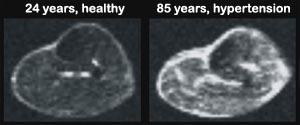
Discovery 1: the white in the X-rays shows the amount of salt in a 24 year old and 85 year old, sodium salt is stored in the body’s tissues and increases with age.
Above all, sodium, salt is stored in the skin and skeletal muscles.
This discovery is particularly noteworthy because salt sensitivity in humans increases with age. The body does not seem to be able to get rid of all the excess salt, but is stored in the body’s tissues.

Discovery 2: the liver needs a lot of energy to produce urea for the kidneys for fluid balance. However, when the researchers removed excess calories during the Mars500 project, then the liver began stealing energy from the muscles instead of from fat stores in the body.
That’s why Titze tells those who are on a diet to minimize salt intake because otherwise it will lead to lost muscle instead of reduced fat.
The interesting thing is that this decrease in muscle mass is similar to that suffered from ALS because then muscle mass also disappears.

One tablespoon is 11 grams of salt.
-1 grams sodium/day is enough as an electrolyte
-2,5 grams sodium/day is highest recommendation
-11 grams sodium/day is average intake
Statistics show that we eat 11 times more sodium salt than we need and too little potassium salt to balance all salt intake.

Professor Johan Sundstrom urges all to reduce the intake of sodium salt and increase potassium.
He says: “Salt contains sodium, which is important for various functions in the body. However, a lot of sodium can raise blood pressure, and this in turn increases the risk of heart attack, heart failure, stroke and kidney damage.”
He recommends cooking yourself with ingredients containing potassium, therefore processed food has a lot of sodium salt.
Important Vanderbilt study in USA showed that anyone who reduced salt intake by one teaspoon a day reduced blood pressure with (6mm Hg), it corresponds to the blood pressure medication they take.

In crease potassium salt and reduce sodium salt when potatoes or pasta are cooked. Avoid extra salted butter, avoid salty chips and salty sweets, read on ingredients which foods contain less salt
Foods that contain more potassium salt.
+Fruits – bananas, oranges, kiwi
+Dried fruits – apricots, plums
+Vegetables – spinach, potatoes, sweet potatoes, tomatoes, broccoli.

If a lot of sodium salt has been consumed over the years, potassium salt is often needed as a dietary supplement, therefore the limited amount found in food is not enough if much.
If the goal is to reduce migraines, potassium supplements are part of the measures on the road to better health. There are various Sodium salts as supplements, potassium chloride often causes a loose stomach and should be avoided.
It is important to know that calcium makes it easier for potassium salt to be transported into the body.
Obstacles to potassium absorption are caffeine found in coffee, chocolate and some sports drinks. Avoid caffeine one hour before and after consuming potassium if it is important to increase potassium in the body.


M Harrington, S Grant. Huntington Medical Research. March 2019. Research team discovers link between sodium and migraines before pain occurs.
W McNeely, K Goa, Drugs. 1999. Potassium in migraine: a review. Jun;57(6):991-1003. doi: 10.2165
J. Titze, M. Rauh et al. Increased salt consumption induces body water… May 2017, Journal of Clinical Investigation
Strazzullo P, D’Elia L, Kandala NB, Cappuccio FP. Salt intake, stroke, and cardiovascular disease: meta-analysis of prospective studies. BMJ. 2009;339:b4567. [PMC free article] [PubMed] [Google Scholar]
Titze J, Kopp C, Linz P, Wachsmuth L, Dahlmann A, Horbach T. (23)Na magnetic resonance imaging of tissue sodium. Hypertension. 2012 Jan;59(1):167-72
Xu WJ, Barisano G, Phung D, Chou B. Structural MRI in Migraine: A Review of Migraine Vascular and Structural Changes in Brain Parenchyma. J Cent Nerv Syst Dis. 2023 Apr 14
Coincon, M., Uzdavinys, P., Nji, E. et al. Crystal structures reveal the molecular basis of ion translocation in sodium/proton antiporters. Nat Struct Mol Biol 23, 248–255 (2016).
Blaustein MP, Leenen FH, Chen L, Wier WG. How NaCl raises blood pressure. Am J Physiol Heart Circ Physiol. 2012 Mar 1;302(5):H1031-49.
World Health Organization. March 2023, Massive efforts needed to reduce salt intake and protect lives
Gunn J. and Levings J. Public health analyst, 2014, The Imbalance of Sodium and Potassium Intake
Jennifer Adler, Passionate Nutrition: A Guide to Using Food as Medicine from a Nutritionist Who Healed Herself from the Inside Out (Seattle: Sasquatch Books, 2014)
Gerard Mullin, MD, The Gut Balance Revolution: Boost Your Metabolism, Restore Your Inner Ecology, and Lose the Weight For Good! (New York: Rodale, 2015).
Katherine Harmon, “Salt Linked to Autoimmune Diseases,” Nature (6 March 2013), republished in Scientific American. http://www.scientificamerican.com/article/salt-linked-to-autoimmune-diseases/. Accessed March 1, 2015.
Michael B. Fowler, MD, “Salt, Hypertension, & Heart Failure” in Gazzaniga, The No-Salt, Lowest-Sodium, Living Well Without Salt Cookbook.
Faraco et al. Dietary salt promotes neurovascular and cognitive dysfunction through a gut-initiated TH17 response. Nature Neuroscience. January 15, 2018. doi:
Costantino et al. Hold the salt: gut reaction may impair the brains of mice. National Institutes of Health. January 2018
National Heart Lung and Blood Institute, National Institutes of Health. Your Guide to Lowering Your Blood Pressure with DASH. Accessed May 14, 2012.
Yang Q, Zhang Z, Kuklina EV, Fang J, Ayala C, Hong Y, Loustalot F, Dai S, Gunn JP, Tian N, Cogswell ME, Merritt R. Sodium intake and blood pressure among US children and adolescents, by weight status. Pediatrics 2012; 130(4): 611–619.
 EN
EN  SV
SV  ES
ES  RU
RU  KO
KO